
FOMC reduces rates “well within neutral”
Summary
On Wednesday, December 10, 2025, the Federal Open Market Committee (FOMC) voted to lower the fed funds rate by 25 basis points, establishing a new target range of 3.50% - 3.75%. Governors Goolsbee and Schmid favored holding rates, while governor Miran voted to lower the target range by 50 bps, demonstrating multiple dissenting votes in today’s meeting. The FOMC noted that they will carefully assess incoming data and the evolving economic outlook to determine the extent and timing of additional adjustments to the target range. Additionally, the FOMC released their projections for interest rates over the next few years, pricing in one cut in 2026 and one cut in 2027. The FOMC projections showed the board increasing their expectations for GDP growth over the next few years with the median projection for 2026 increasing from 1.8% to 2.3%. This suggests a more resilient economic backdrop than previously anticipated. Additionally, the Federal Reserve will begin purchasing short-term treasuries to address reserve balances that have fallen to ample levels as they aim to manage market liquidity.
Impact on rates
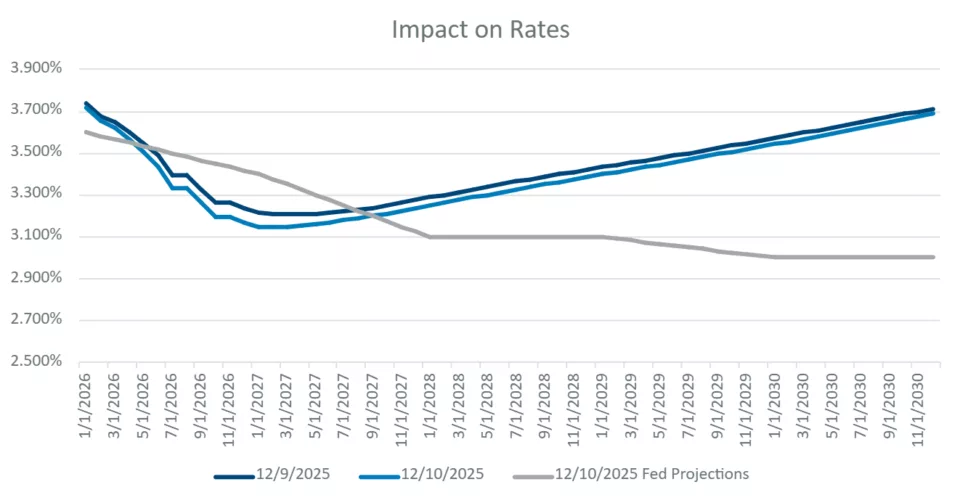
After Chair Powell’s post-meeting press conference, SOFR swap rates moved lower, with the 2-year rate declining roughly 6 bps on the day and the 10-year decreasing by 3 bps. The market is pricing in more aggressive rate cuts than the Fed’s projections: current 1m Term SOFR forecasts are at approximately 3.15% for the end of 2026 compared to the FOMC’s projections at 3.40% for that same period. Rates moved noticeably lower after Powell noted that recent jobs data appear overstated and are likely to face sizable downward revisions. Investors interpreted these remarks as an acknowledgment of labor-market softening, supporting expectations for faster and deeper rate cuts than the Fed has explicitly signaled. Many of the questions directed at Chair Powell focused on Artificial Intelligence’s (AI) impact on productivity and the labor market. Chair Powell noted that AI poses a threat to the labor market as many companies have either started layoffs or paused hiring due to AI implementation, however he shared the idea that every technological revolution has ultimately created new types of jobs that replaced those lost due to technological innovation.
Source: Chatham Financial
Moving forward
Moving forward, the market will be laser focused on employment and inflation data, as the Fed is working to balance their dual mandate of maximum employment and 2% inflation. The FOMC did note that the downside risk to employment has risen in recent months, signaling there could be room for further deterioration, leading to more rate cuts. Chair Powell maintained that the FOMC will remain data dependent while also acknowledging that the current target range is well within the range of neutral estimates. The FOMC believes that tariff-induced goods inflation is a one-time price increase expected to peak in Quarter 1 of 2026, but they may need to adjust their policy stance if additional tariffs are announced. The market is currently pricing in a hold at the next FOMC meeting on January 28, 2026. Overall, the market is priced for a more dovish trajectory than the Fed is signaling, leaving the potential for volatility as these views converge.
Subscribe to receive our market insights and webinar invites
Disclaimers
Chatham Hedging Advisors, LLC (CHA) is a subsidiary of Chatham Financial Corp. and provides hedge advisory, accounting and execution services related to swap transactions in the United States. CHA is registered with the Commodity Futures Trading Commission (CFTC) as a commodity trading advisor and is a member of the National Futures Association (NFA); however, neither the CFTC nor the NFA have passed upon the merits of participating in any advisory services offered by CHA. For further information, please visit chathamfinancial.com/legal-notices.
25-0123